Twenty Minutes of Warm-Up: Turning Your Screening Lobby Into Act One
The house lights go down, the projector coughs to life, and everybody settles in. That is the version of the night most filmmakers plan for. The other twenty minutes — the ones between the first person through the door and the first frame on screen — usually get whatever attention is left over after the sound check and the parking instructions.
That is a mistake. The lobby is not the waiting room for the movie. It is the first scene. It sets the temperature, tells people whether they are in the right place, and quietly decides whether anyone will stick around for the Q&A or the next Ziggy Films night. You do not need a budget to run it well. You need a sequence.
The Lobby Is the Opening Scene
A first-time attendee walks in with three questions running at once: Am I in the right room? Where do I sit? What am I supposed to do with my hands? Every good pre-show decision answers one of those questions without anyone having to ask. Every bad one — an unstaffed table, a silent room, a stack of programs nobody touches — adds a tiny friction that builds into a distracted audience.
The goal of the twenty minutes is simple: lower the social cost of being there. People should be able to arrive alone, grab a drink, learn one thing about the film, and feel like they belong before the lights drop.
The 20-Minute Sequence
Think of it as a countdown from doors-open to picture-up. Exact clock times will shift with your venue, but the order holds.
Minutes 0–5: Open clean and visible. One person stands near the entrance, not behind a table. The sign-in sheet is already out, the music is already on, and the programs are fanned so they look like they are meant to be taken. No last-minute tape runs, no frantic searching for the extension cord. The first five minutes are for eye contact and orientation.
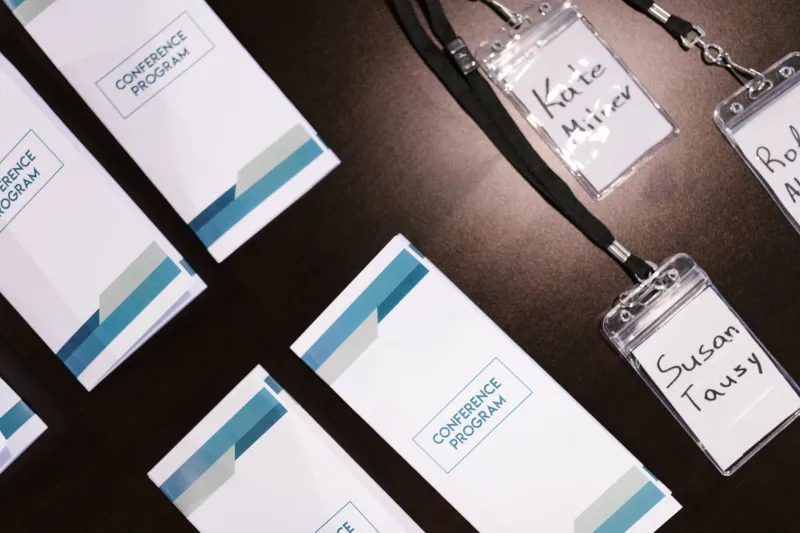
Minutes 5–12: Give people a job. Sign in, take a program, grab a sticker. A small task is a social lubricant. It gives a stranger a reason to stand near another stranger without having to invent a conversation. This is also when you mention the mailing list — more on that below.
Minutes 12–18: Let the room hum. Do not make announcements yet. Let the playlist do the work. Check in with the projectionist, restock the program pile, and watch the room. If you see someone standing alone by the door, that is your cue to walk over and say something that is not about the movie.
Minutes 18–20: Frame the night. Two sentences, maximum. Welcome people, name the film, point to the exits and the restrooms, and tell them there will be a short Q&A after. Then get out of the way. The movie is the host now.
Signage That Answers Three Questions
You do not need a full vinyl banner. You need three readable signs, placed where people actually look.
- At the door: the film title, start time, and a line that says “No ticket? See the table.” This catches the plus-one who did not get the email.
- At the sign-in table: a single instruction — “Sign in here. Programs are free.” Nothing else competes with it.
- At the theater entrance: “Q&A after the credits. Stay if you can.” This one small sign keeps a third of the room from bolting the second the lights come up.
Use large type. Test the signs from ten feet away in the actual lobby light. A beautiful design that cannot be read from the doorway is just decoration.
The Playlist: Low, Local, Legal
Music in the lobby should be background, not a concert. Aim for something instrumental or low-vocal, around the volume of a quiet coffee shop. If you have a local band or composer in your credits, this is the moment to play them — it ties the room to the film before the film starts.
Keep it legal. A streaming service on a personal account is not a public performance license. Use royalty-free tracks, music you have written permission to use, or a licensed playlist service. A twenty-minute loop is plenty. Fade it out at the two-minute mark so the room can settle.
The Sign-In Table That Actually Earns Its Keep
A clipboard with a pen is fine. A clipboard with a pen and a clear reason is better. Put the mailing list line right on the sheet: “Want to hear about the next Ziggy Films screening? Add your email.” Do not make it a separate form. Do not make it a QR code that leads to a six-field survey. One line, one box, one pen.
Staff the table for the first fifteen minutes, then let it be self-serve. The person working it should be able to answer three things: where the bathrooms are, whether there are tickets left, and how long the movie runs. That is it. Everything else is a bonus.
One Object People Can Hold
A program is good. A program that feels like an object is better. A folded card with the film title and a single production still costs very little and gives people something to flip through while they wait. A sticker or a button does the same job in a smaller package — and it travels home with them.
The rule is tactile and cheap. One item, not a goody bag. It should feel like a souvenir of the night, not a piece of junk mail. If you are screening a short block, print the running order on the back. If it is a feature, put the director’s name and one line about the shoot. That is enough.
A Sample Micro-Budget
- Three printed signs at a copy shop: $12
- 100 folded program cards: $35
- 100 stickers: $25
- Royalty-free playlist license: $0–$30
- Clipboards and pens: $8
- Snacks for the table (optional): $40
Total: roughly $80–$150, depending on what you already own. Most of that is reusable. The signs can be reprinted with a new title. The clipboards do not expire. The playlist can become your standard lobby loop.
Checklist for a Venue That Has Never Shown a Film
- Confirm the projector, the screen, and the sound source in person, not over email.
- Ask who controls the house lights and where the dimmer is.
- Test the HDMI cable and bring your own adapter.
- Ask whether the lobby music is allowed and at what volume.
- Confirm the start time, the door time, and the load-out time in writing.
- Find out where the nearest outlet is and whether you need tape.
- Ask if there is a table you can use for sign-in — and whether it can be moved.
- Get a phone number for the person on duty that night.
The lobby is not a holding pen. It is the first twenty minutes of the movie, and it is the only part of the night you can rehearse without the film. Treat it like a scene. Block it, light it, give the audience something to do, and then get out of the way.