Twelve Minutes, Scripted: Designing a Screening Break That Doesn't Leak Energy
Photo: Unknown, Public domain, via Wikimedia Commons
Watch a room during a badly planned intermission and you can see the energy leave. People check phones. Someone starts a conversation about parking. By the time the second half starts, you are not reopening a film, you are restarting one, and you have lost the ten people who decided the night was effectively over.
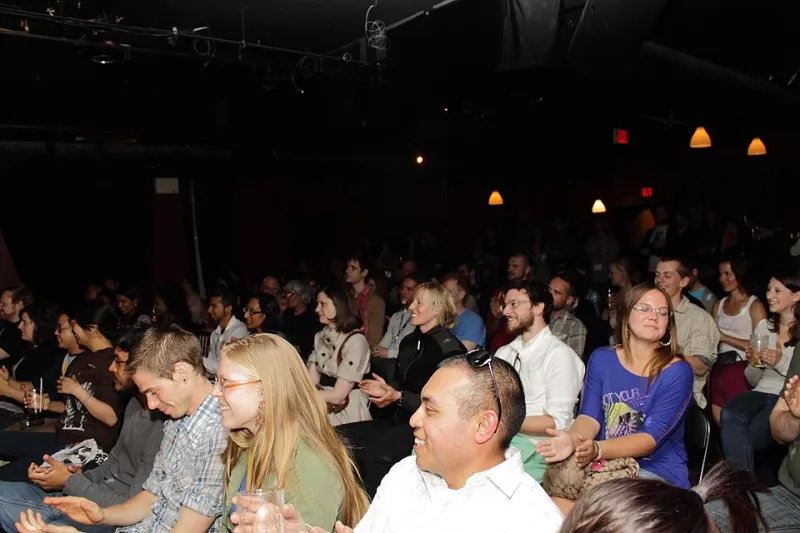
Watch a room during a well-planned one and something else happens: strangers turn to each other, the snack table becomes a place to linger, and when the lights come back down the room is warmer than it was at the top of the night.
The difference is not budget. It is whether somebody treated those twelve minutes as a scene — with a beginning, a middle, an end, and blocking.
The break is a scene change, not a pause
A pause is what happens when the projector stops. A scene change is what happens when the room is moved from one state to another on purpose. If you are running a shorts block, a double feature, or a feature with a genuine reel break, the intermission is your only chance to reset attention. Treat it like a cut, not a fade.
Three things have to be true by the end of it. Everybody has what they need physically — bathroom, water, snack. Everybody has something to say to the person next to them. And everybody knows, without being told twice, exactly when to sit back down.
Time it in blocks, not in minutes
Twelve minutes sounds short until you are standing in it. Break it into four blocks and write them down.
- 0:00-0:02 — Stand and orient. House lights to about 70 percent, not full. Music comes up before anyone moves. A person at the front says one sentence and only one sentence: we are back in twelve minutes, snacks are in the back, the bathrooms are to the left.
- 0:02-0:08 — The open middle. This is the only part that should feel unstructured. Snacks, bathroom line, conversation. Do not schedule anything here. Do not make announcements here.
- 0:08-0:10 — The return signal. Three-part, repeated twice, so nobody has to guess.
- 0:10-0:12 — Settle. Music down, lights to 40, then to black. Latecomers come in during the settle, not during the first shot.
Notice that the last two minutes exist purely so the first shot of the second half lands on a seated room. If you skip the settle, you will spend the first ninety seconds of your best scene lit by the glow of people finding their seats.
Snack cues that move a line
A snack table is a queue waiting to happen. Break the queue before it forms.
Pre-portion what you can. Paper cones of popcorn, small bags of chips, cups already poured. Put the snacks at two or three separate stations rather than one long table — two short lines move faster than one long one, and people who are not queuing are talking, which is what you want.
Put the trash plan next to the snacks, not across the room. A labeled bin within arm's reach of the table catches most of it. Bring a roll of paper towels and a spray bottle even if the venue has them, because the venue's supplies will be in a closet and the closet will be locked.
And if the room is borrowed, confirm before the night that you can use the kitchen or that you cannot. Discovering at 7:40 that you have no access to a sink is the kind of thing that turns twelve minutes into twenty.
The prompt card on every seat
This is the cheapest, highest-leverage thing in the whole plan. Before doors, tape or set a small card on every seat with a single question printed on it. Not a survey. A question about the film.
Examples that work for a shorts block:
Which of the first three shorts would you want to see as a feature? Tell the person next to you.
Whose performance surprised you most so far, and why?
What was the last shot you remember, and what did it make you expect?
For a double feature, give the card a different job: ask the room to predict where the second film is going, based on the first. It primes attention instead of just filling time.
Print them on card stock if you can, plain paper if you cannot. Either way, have a second batch at the door for the people who arrive late and never sat in their assigned seat.
Returning the room without a PA
No microphone, no bell, no app. Three signals, staggered, each one catching a different kind of person.
- Music up. The house playlist goes from background to foreground for about ninety seconds. Choose something with a clear ending; you want the track to finish, not to be cut.
- Lights down to 60. The shift in light pulls eyes before it pulls bodies.
- A person at the front with a raised hand and a voice. Not shouting — projecting, the way a stage manager calls places. We are seating in two minutes.
Repeat the sequence twice, three minutes apart. The first pass catches the people who were waiting for permission. The second catches the people who were mid-conversation and did not hear the first.
The five-line host script
Whoever is running the night should have this memorized, or taped inside a notebook. It is five lines and it should take forty seconds.
We are back in twelve minutes. Snacks are back there, bathrooms are out the door and to the left. There is a card on your seat — read it, then ask the person next to you. When the music comes up the second time, that is your cue. Enjoy the break, and thank you for being here.
That last clause matters more than it looks. People who are thanked at the break tend to stay for the credits.
For doubles and shorts blocks, break differently
A double feature needs one break, at the natural hinge between films, and it should be a little longer — fifteen minutes — because the audience is also processing what they just watched.
A shorts block is the opposite problem: no single hinge, so you invent one. Put the break two-thirds of the way through the program rather than dead center, and put your strongest short immediately after it. The energy of the break should carry into something, not into a palate cleanser.
If your block runs under an hour, do not break it. Just let it run. A twelve-minute break inside a fifty-minute program is a longer interruption than the thing it interrupts.
Run it once with six people
Before you do any of this in front of a paying room, test the return signal in the actual space with six friends. Put on the music, drop the lights, stand at the front, and see how long it takes them to sit. If it takes more than ninety seconds with six cooperative people, it will take four minutes with sixty.
Then write the timing on an index card, tape it to the projector table, and let the break be the one part of the night that runs exactly as long as you said it would.