The Aisle-Side Cinema: Building a Festival Booth That Speaks Before You Do
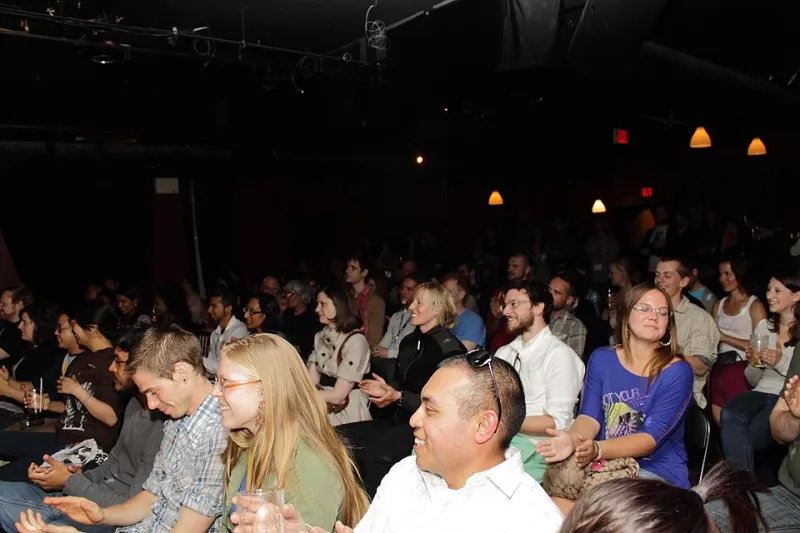
Photo: Canadian Film Centre from Toronto, Canada, CC BY 2.0, via Wikimedia Commons
Walk a crowded festival floor for ten minutes and you can tell which booths were built for the walk-by and which were built for the people already standing there. The difference is not budget. It is whether the booth works before a word is spoken. At Ziggy Films, we think about trailers for a living, and a festival booth is basically a trailer you can stand inside: a few seconds to catch an eye, a clear title, and a reason to keep watching.
For the 2026 festival season, plenty of indie teams will load a folding table, a laptop, and six posters into a car and hope for the best. That can work. But if you want the aisle to do some of the recruiting for you, treat your six feet of floor space like a tiny cinema with a very impatient audience.
Start With One Object, Not a Collage
The fastest way to disappear on a festival floor is to display everything. Six posters, three costumes, a stack of postcards, a laptop playing a different cut every five minutes — it reads as noise from twenty feet away. Pick one focal object and let it do the heavy lifting.
That object can be a prop from the film, a single enlarged still, a costume on a dress form, or a monitor showing one perfect frame. The key is scale and contrast. A bright yellow chair against a black backdrop will pull eyes from across a convention hall. A detailed collage of production photos will not. Put the object at roughly chest or eye height so it reads over shoulders and through the crowd. Add one line of text nearby — the title, maybe a festival laurel — and resist the urge to explain the whole plot.
Think of it as the first frame of your trailer. You are not trying to answer every question. You are trying to make someone ask one.
Cut a Loop for Peripheral Vision
If you have a screen, build a silent loop specifically for the booth. Not your full trailer with dialogue and a slow build. A booth loop has to survive bad sightlines, bright overhead lights, and people who are already halfway to the next table.
Aim for fifteen to twenty seconds. Use large, legible frames. Put the title on screen more than once. Add a simple caption or two that can be read without sound. If your film is dialogue-driven, choose moments that still make sense muted — a look, a gesture, a strange object, a punchline that lands visually. Loop it cleanly, and make sure the first frame and the last frame do not create a jarring cut. You want the loop to feel like a window, not a glitch.
Size matters, too. A laptop screen is fine for a conversation, but it disappears on a busy floor. A modest TV or large monitor at eye level is better. Keep the brightness high, tape the cables down, and test the loop from six feet away, then twelve. If you cannot tell what it is from twelve feet, simplify it.
The QR Is a Handoff, Not a Lecture
A QR code is not a pitch. It is a handoff. The best booth codes send someone to one page that loads fast on a phone, plays the trailer, and offers a clear next step. No email gate. No six-tab website. No PDF press kit as the first click.
Make the code big enough to scan from a comfortable distance, and put a short instruction above it: “Watch the 90-second trailer.” Test it on an old phone, on a bad signal, and with the venue Wi-Fi turned off. Print a backup code on card stock in case the display gets smudged or the tape gives up. Keep the destination page simple: title, logline, trailer, one festival date or screening link. That is enough.
The handoff also means you do not have to launch into a speech every time someone glances over. You can nod, point at the screen, and say, “Trailer is right there.” That lowers the pressure for both of you. Some people will scan and walk. Some will stay. Both are wins.
Lay Out the Six Feet Like a Shot List
A booth is a sequence. The first zone is attraction: the object, the screen, the one line of text. The second zone is handoff: the QR code, postcards, a small sign with the title. The third zone is conversation: a little open space where you can stand without blocking the table.
Keep the table shallow. A deep table becomes a wall. Stand to the side rather than behind the middle, so the aisle stays open and people can drift in. Put the tallest elements at the back, the handoff materials at waist height, and nothing important below knee level. In a crowded US festival floor — a convention center, a hotel ballroom, a union hall with tired carpet — sightlines are everything. Build for the aisle, not for the people already inside your booth.
Also build for bad infrastructure. Venue Wi-Fi is a rumor. Power outlets are a negotiation. Bring a charged battery pack, a power strip, gaffer tape, a cleaning cloth, and a printed backup of your QR code. Assume the floor will be louder, dimmer, and more chaotic than the layout drawing suggests.
Rehearse the Silent Shift
Before the festival, stand six feet away from your own booth and look at it for ten seconds. What do you see? Can you read the title? Does the loop make sense? Is it obvious where to scan? If a stranger walked by, would they know whether they were interested?
Then practice the first sentence you will say when someone stops. Keep it short and specific. “It’s a short about a family that communicates through radio static” is better than “It’s kind of hard to explain.” The booth should do the introducing. You are there for the follow-through.
A good festival booth is not a storefront. It is a title sequence with a floor plan. It gives the aisle a frame, a glance, and a way in. If it works before you say a word, you have already cut the hardest trailer of the weekend.