Hinges, Gravel, and a $12 Contact Mic: A Hardware-Store Foley Rig That Mixes Clean
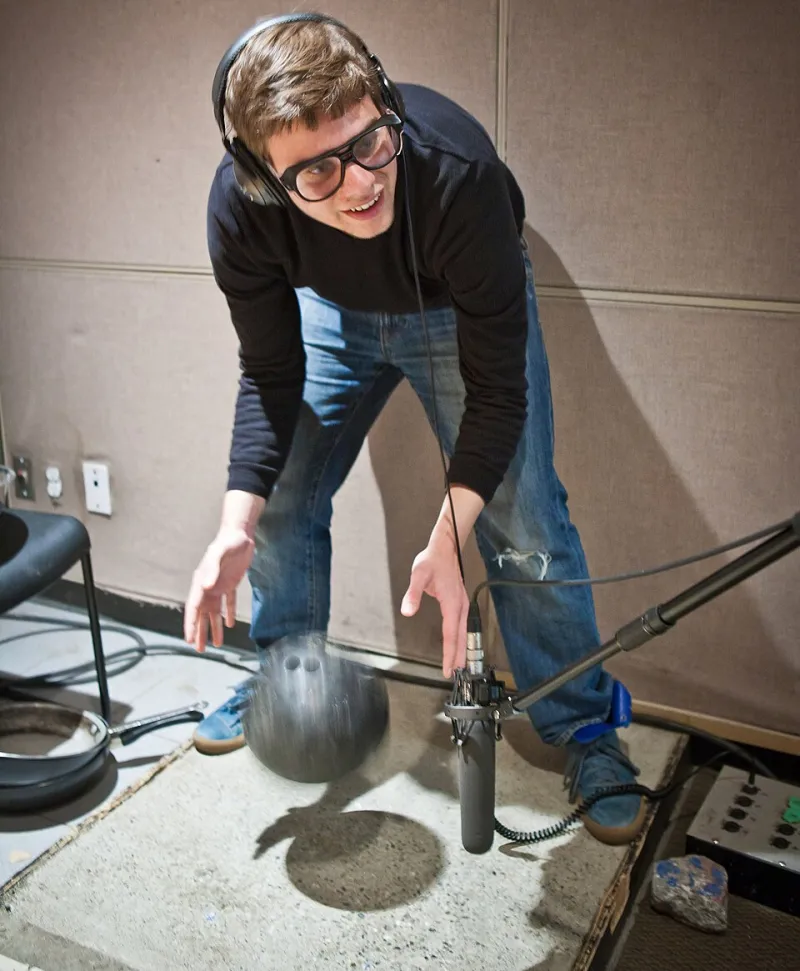
Photo: Vancouver Film SchoolRetouched version by User:Quenhitran., CC BY 2.0, via Wikimedia Commons
The first time you watch your own cut with real sound design under it, you learn something uncomfortable: the picture was fine, and the silence was the problem. A room with no cloth movement and no floor under the feet reads as a video, not a film. It does not read as low budget. It reads as unfinished.
The good news is that the fix is cheap and mostly physical. Foley — the art of performing and recording the small sounds a scene needs — is the one department where a hardware store genuinely competes with a rental house. You are not buying a Neumann. You are buying a hinge.
What goes on the shelf
Build the kit around three sound families that appear in nearly every micro-budget film: feet, cloth, and hands-on-objects. Everything below totals roughly $200 if you already own a laptop, an audio interface, and a pair of closed-back headphones.
| Item | Why it earns its place | Approx. cost |
|---|---|---|
| Folding table, 4 ft | The pit. Everything gets performed on or beside it. | $35 |
| Bag of pea gravel + shallow baking tray | The single most versatile footstep surface you can own. | $12 |
| Three loose door hinges | Creaks, groans, gate opens, old-house texture. | $9 |
| Fabric swatches — denim, canvas, corduroy, silk, flannel | Cloth passives for every character in the film. | $15 |
| Contact mic (piezo, wired) | Picks up hinge and gravel detail a condenser misses. | $12 |
| Small condenser or a decent lav | The main mic for cloth and feet. | $70 |
| 10 ft XLR cable | Because the good take always happens at the end of the cable. | $14 |
| Two moving blankets | Kills floor reflections and doubles as a surface. | $24 |
| Rubbermaid tub + foam scraps | Storage, and the tub itself is a great body-prop. | $12 |
Add a pair of cotton gloves, a spray bottle, and a notebook you do not care about. Total lands near $200, less if you borrow the condenser.
A note on the contact mic: it is the sleeper of the kit. Tape it directly to a hinge, to the tray of gravel, or to the underside of the table and you get an intimacy that a mic three feet away cannot reach. It is not a full-range microphone and it will not replace your main mic for footsteps, but for creaks, scrapes, and gravel detail it is the difference between generic and specific.
Set up the room before you touch a prop
Foley is 60 percent setup. Do the boring part first and the session goes three times faster.
- Pick the quietest room you have access to. A carpeted bedroom beats a garage. Turn off the fridge, the HVAC, the ceiling fan. Put phones in another room, not on silent — a phone on a table buzzes.
- Lay one moving blanket on the floor as your performance surface and hang the other behind the mic stand to catch reflections.
- Set the folding table to your hip height. You will be standing for most of the session and reaching for props constantly.
- Place the main mic six to twelve inches from the performance area, pointed slightly off-axis so you do not record wind from your own movement.
- Set the interface to 48 kHz, 24-bit, and gain-stage so your loudest footstep peaks around -12 dBFS. Leave the headroom. You can always turn it up in the mix, and you cannot un-clip a stomp.
The three-hour session plan
Three hours is enough for a short film and enough for a feature trailer. Work in blocks and record a fresh room tone between each one — you will thank yourself in the edit.
0:00-0:20 — Tone and slate. Record sixty seconds of silence in three positions: at the table, at the doorway, and at the far wall. Slate each one out loud. This is the most boring twenty minutes of the day and the most useful.
0:20-1:05 — Feet. Do every character separately. Walk in place on the blanket for carpet, on the gravel tray for exterior, on a bare floor tile for kitchen, in hard shoes and soft shoes. Record each at three intensities: idle, normal, urgent. Sixty to ninety seconds per pass is plenty; you will cut from it, not listen to it.
1:05-1:40 — Cloth. Sit in a chair, lean forward, stand up, cross your arms, put on a jacket, sit down again. Do it in each fabric swatch you brought. This pass is quiet, so raise gain slightly and watch the noise floor.
1:40-2:20 — Hands and props. Hinges on the table edge, latches, keys, a glass set down, a mug picked up, a bag of gravel dragged across wood, a door closing gently and then not gently. Perform each action five times in a row without stopping. Take five is always the usable one.
2:20-2:45 — Room tone variants. Same room, but with a window cracked, with a fan running, and with a body in the room. Tone is not a single file; it is a palette.
2:45-3:00 — Wild takes. Anything you noticed during the session but did not plan. The hinge that squeaked in a specific key. The tray that sounds like a car door when you drop it. Record it, label it, move on.
The labeling system that saves the edit
If you take one thing from this article, take this. Foley that cannot be found is Foley that does not exist.
Name every file with the same five fields, separated by underscores:
2026-11-14_kitchen_boots-wet-gravel_t03.wav
That is date, scene or space, action-descriptor, take number. No spaces, no capital letters, no final version anywhere in the name.
Keep a paper log while you record. One line per take: file number, what you did, which mic was live, and any note like mic bumped or dog barked. Transfer the log into a spreadsheet the same night, while you still remember the difference between take 3 and take 4. Add a column for a one-word quality rating — clean, usable, noisy — so the editor can sort instead of audition.
In the edit, group by scene folder, then by action family. Give the editor a README text file in the root folder explaining the naming convention. It takes four minutes and it buys you goodwill you will need later.
Making it survive a festival mix
A festival mix is a stress test. It plays in a room you have never heard, on a system with more low end than you own, at a volume set by a projectionist you will never meet. Three habits keep your Foley alive through that.
High-pass almost everything. Footsteps, cloth, hinges — roll off below 60 to 80 Hz unless there is a specific reason not to. The subwoofer in the venue will add weight you cannot predict, and a boom you did not intend is a boom the audience hears.
Check in mono. Sum your Foley bus to mono and listen. Phase cancellation between two mics on the same action is the most common reason a sound disappears in a theater but sounds fine on headphones.
Layer instead of pushing. If a footstep feels small, do not turn it up. Add a second, quieter element underneath — a gravel scrape, a hinge tick, a cloth rustle. Volume draws attention; texture earns it.
And leave headroom on the whole Foley bus. Aim for it to sit under dialogue without ducking, so the mix engineer has somewhere to go. The kit cost you two hundred dollars. The restraint costs nothing.